
USRB
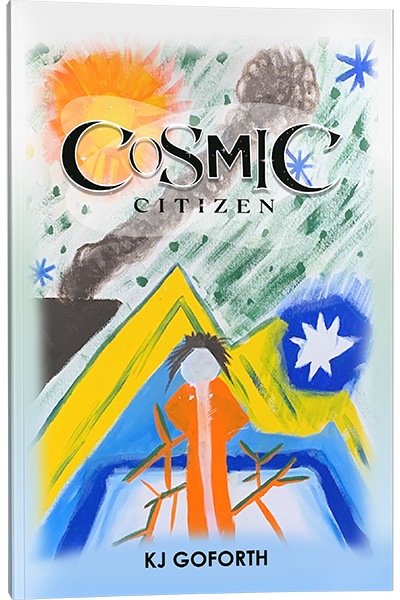
Cosmic Citizen
“Flow with style flow with grace
Wear that smile upon your face”
Declaring “love flows back to those who give love without strings,” GoForth’s collection presents eighty pages of delightful poetry, which seemingly could have been composed off-the-cuff extemporaneously, yet which stand together well as a solid unit, consisting entirely of end-rhyme couplets that flow naturally page to page. Written in a pleasing manner, the book includes topics such as freedom, seeing things as they truly are, love and new beginnings, gratitude, wisdom, liberation, compassionate existence, and more. The entire collection can be regarded as one continuous poetic outpouring, as no titles are given for any piece except the closing one. Simply titled “To Mom,” the final poem describes the “grace and beauty of an angel,” living life with “pureness of heart.” It notes the poet’s mother’s courageous composure required to ascend life’s steep hill. GoForth ends the poem confidently with “Peace is at hand.”
These are pages of poetic joy, at times tempered with the “rough stuff” of life but always veering—as the old jazz classic declares—on the sunny side of the street. GoForth seems a poet for the everyman. Summoning elements of universal life with which any reader can definitely relate, he speaks truth in gentle, down-to-earth, accessible terms. As this is a relatively short poetry collection, the reader will likely take in the entire book in one or two relaxed, enjoyable sittings. Utilizing commonplace everyday language, GoForth’s poetry inspires in an unapologetically unpretentious manner, such as when he writes, “Free up your mind glow from the heart / Carry the goodness that sets us apart,” adding: “The soul is amazing it won’t let you down / So find it and let it spread joy through your town.” This poetry pleas for an embrace of all that is precious and good.
— The U.S. Review of Books (2022)
Book review by Jonah Meyer

USRB
Glimmer of Hope
“Hold out your hand she said to me
I am the magic you are the key”
The roughly seventy-five pages in this collection of free-flowing, expansive poetry touch on a rich array of diverse, universal themes. Several topics are explored through the poet’s imagination and served up fresh, like a delicious meal for readers of inspired verse. These include, among other subjects, the feminine nature and spirit of beauty, music of a multitude of instruments, love and its discontents, God’s abundant universe, getting back up when life throws one down to the ground, grace and sin, shining free with growth, healthy questioning of those in authority (who often act with ulterior, fear-spreading motives), and so much more. GoForth is not new to the game of producing thought-provoking, sprawling collections of poetry, and this book, like his others, has much to offer.
Written in the author’s usual style and method, this is not a “traditional” poetry collection wherein there is a set number of distinct poems, each titled and self-contained. Rather, the entire relatively short collection can—and likely should—be read and taken in as one long, thoughtful flow of continuous poetic exploration. Consisting entirely of two-lined couplets, complete with the pleasing music of end-rhyme, the one exception to this format is the final piece entitled “Daughter I Never Had.” Here, GoForth expresses a heartbreakingly beautiful communication to his child, acknowledging in retrospect an absence of fatherly connection while simultaneously expressing guidance, love, and support. The poet encourages his daughter to embrace her ‘inner child,” telling her to “Be the princess you’ve dreamed of,” and letting her know in no uncertain terms that he is here to catch her when she twirls. The sentiment GoForth evokes with this poem—much like the rest of the book’s entirety—is humbling, graceful, and true to the heart.
— The U.S. Review of Books (2023)
Book review by Jonah Meyer

USRB
Vintage Rituals
“Hostage no more life is no bore
Kind and brave don’t need to be saved.”
At its core, Goforth’s poetry is a call to action, entreating audiences to connect with their inner spirit and live one’s truth with unconditional authenticity. Themes like courage, freedom, and sink or swim are intricately woven into a tapestry of vivid imagery like turbulent seas and burnt bridges. Using a primarily AABBCC rhyme scheme, Goforth’s commentary tackles many of the issues that most plague today’s society and the modern human: self-image over what’s inside, abusing Mother Earth’s gifts to mankind, unrelenting fear, and a nagging feeling of being lost in an ever-evolving and technologically advancing world.
The running discourse throughout the compilation is delivered through rhyming couplets that add emphasis and meaning to help audiences understand the devastating impacts of vices like greed and corruption, which often stem from having too much power and authority. Further, through kindness and bravery, life’s shackles will come off, and one can lead his or her best life.
Throughout, metaphors and idiomatic phrases are a mainstay. Whether it is “drunk on power” or “ashes to ashes, dust to dust,” there is a constant juxtaposition of addiction and salvation and the ramifications of both. Interestingly, in a world so dense with division, the author makes shedding labels and loving others for who they are a central focus in creating a world of peace that is ripe for awakening its energy and tapping into its full potential. Overall, Goforth has a strong command of figurative language and finds a way to deliver extremely important topics of conversation in an easily digestible manner for all readers.
— The U.S. Review of Books (2023)
Book review by Mihir Shah
2nd Review
“Together as one is our true power
How to get there my question this hour.”
This book of verse delves into the condition of humanity in a collection that questions the authority of religion, the state of the country, and the responsibility of individuals to care for the earth. Written in rhyming couplets, the author uses irony, metaphor, and alliteration to create these accessible verses. Poems that question the authority of religious leaders and the duplicity of political leaders challenge one to seek truth. Accompanying these social issue poems are ones that urge readers to take personal responsibility for their lives and actions, with lines such as “Citizens of the multiverse rise and awake / We are here to cause a shake.” Goforth’s poetry also includes personal struggles: “Thirsty hungry free my soul / Stop the pain and its toll.”
Though a slim volume, this collection brings together the author’s reflections on social issues and personal struggles. This collection’s main theme is a call to action, with the author challenging readers to seek truth and embrace personal responsibility. Goforth calls for one to “Do a solid save the earth.” Some of the most powerful verses concern organized religion and its abuse of power: “Religion and division it’s done well / Prophets speak of a place called hell / Dose of fear for mankind / Casting shadows on divine.” The couplets flow in a playful manner that is in juxtaposition with their serious message. Goforth urges readers to question religious authority while embracing spirituality. His comments on social issues challenge readers to seek unity which “is our power.” Goforth calls readers to seek truth and not be fooled by authorities whose greed and manipulation keep them from becoming strong in their true nature. The author’s dedication to questioning institutions of religion and politics is evident throughout this enlightening work.
— The U.S. Review of Books (2024)
Book review by Kat Kennedy
USRB
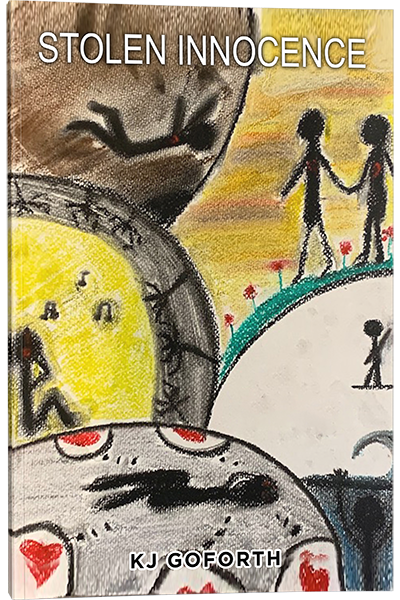
Stolen Innocence
“Another lifetime on the cosmic wheel
With a message to reveal.”
In this poetry collection, readers discover poems celebrating growth, transformation, regrets, and the difficult situations that make a person unique. Other pieces explore faith and spirituality and the myriad of ways those appear in a modern world. Some poems even call for “Godspeed prayer” to make the journey a bit easier. As readers progress through the collection, they discover that a few of the selections celebrate that moment in which one person finds the “one that holds this heart.” A few of this book’s verses even question how society blurs the lines between sex and love and explore the consequences of this blurring. Loss is also a significant theme, but for every loss on which the speaker reflects, there is also a self-discovered path to clarity and recovery. As the book concludes, the speaker explores the power and confidence that develop when one pursues one’s true purpose in life.
The collection’s speaker exhibits a defiant, rebellious voice in each poem. As readers progress throughout the book, they are swept into each piece’s rhythm and momentum because of this voice. The voice also gives the entire collection the quality of a spoken-word performance. Many of the poems possess a rhyme and rhythm reminiscent of hip-hop songs. The work also uniquely blends artwork with poetry, and the page accents create a unique visual experience. For readers who appreciate rhyming poetry with a music vibe, this collection will be an appealing read. Others who enjoy poetry that reads like a personal conversation will also appreciate this book..
— The U.S. Review of Books (2024)
Book review by Nicole Yurcaba
USRB
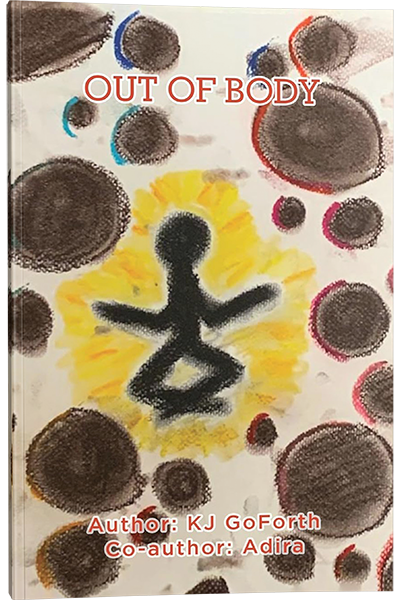
Out of Body
“Be your power let it shine
Don’t be the wino drunk on wine”
This poetry collection takes readers to a “weeded garden” where “ripened fruit” grows and readers are encouraged to “show the world how you flow.” These verses ring with an intriguing voice that invites readers much like an age-old friend invites one to a daily conversation. The poems celebrate personal discovery, and they also encourage readers to “Never back down, always stand tall.” Other poems encourage readers to be aware of the natural world around them by coming “ out of your cave” to “paint a new wall.” Many of the verses focus on the individual’s power to choose freely and live life according to their own will by declaring, “I am the master of my own desires.” The “good vibrations” of living with a positive attitude and spreading positive vibes will inspire readers to go forth and be a good influence on others. Some poems even question society’s materialistic focus.
For readers who appreciate rhyme, this collection is a must-read. The rhyming lines help create each poem’s unique voice. The rhyme also makes the poems’ messages memorable and accessible. Minimal line sketches accompany the poems. These sketches provide a visual concept of the poems and add an artistic flair to the collection. Many of the poems possess a defiant voice that questions politics, religion, and personal circumstances. Admirably, the speaker in such poems provides balance by emphasizing the power an individual possesses to pursue their own paths. The poems bear a distinctive, spoken-word quality, and this might appeal to readers who appreciate hip-hop or spoken-word poetry performances.
— The U.S. Review of Books (2024)
Book review by Nicole Yurcaba

USRB
Driving Blind
“Now times are different but still the same
The rules of the game still haven’t changed”
In this poetry collection, history’s cycles repeat, and readers discover a speaker who contemplates free will, salvation, and other emotional waves and undulations one experiences in life. Defiant and critical of church ideologies that have dominated society for centuries, the speaker questions the reverence of “Mother Mary,” who “birthed a god,” and describes the birth as a “fraud.” Other poems encourage readers to consider life’s superficiality and then strive to find a deeper meaning. Some of the poems even reflect on America’s colonial past, which saw the uprooting and slaughter of millions of Native Americans. The poems place such historical events in correlation to today’s events, such as war. The poems also offer a subtle critique of money, capitalism, and the focus on wealth as a definition of oneself in society.
Each poem in this collection carries a bold and defiant voice. At times, the poems possess a musicality. This musicality forms because of each poem’s reliance on rhyme schemes that repeat throughout the collection. Some of the poems read like spoken word pieces or hip-hop songs. The collection carefully balances the themes of politics, history, and romance. Overall, the poems encourage readers to discover and employ their free will. The poems also encourage readers to defy the systems that ensnare and oppress them and fully rely on the self for happiness and fulfillment. Other poems encourage readers to rediscover their inner child and once again approach the world in which they live with wonder and curiosity. Readers who appreciate rhyming poetry will like this collection.
— The U.S. Review of Books (2024)
Book review by Nicole Yurcaba

USRB
A Soul Set Free
Vol. 1
“It underlines the importance of self-awareness,
the art of balance, and the enduring power of genuine,
unadulterated love.“
GoForth’s timely text works relentlessly to highlight religious ideologies as a catalyst of division—and often much worse. In the process, the countless moments of bloodshed throughout history are recounted to demonstrate the continuation of ancestral trauma that humanity is ensnared in. In a refreshing fusion, the author segues from a purely religious discussion to a more spiritual one, one that is centered on finding peace by calming the mind and being free from manipulation and conformity via compassion, peace, and, at its root, love. One of the terms that GoForth often mentions is collective energy, and it is this notion that we are all linked in some capacity on a cosmic level that presents tremendous intrigue.
GoForth’s natural and authentic storytelling ability delivers numerous relatable examples, describing the ability of institutions to control and condition souls rather than prepare them for a true, genuine, and unfiltered interpretation of religious texts. On a deeper level, what helps this work stand out within the realm of faith-based works is the author’s ode to the Earth and the subsequent salient point that regardless of our origin story, the known factor is that Mother Earth is what sustains us. Our sacred bond to her should be upheld to the utmost degree.
Structurally, in every segment of the work, the author supplants his rationales with a section entitled “Personal Notes” that speaks to his own humanness. Above all else, his work is a guide map to recognize the need to free oneself from baseless perceptions and notions of conformity that only feed the purpose of those in positions of power. Moving past love for possessions and embracing a universal and empowering love, as Goforth demonstrates, is what ultimately harbors the potential to unleash the innate power of the soul.
— The U.S. Review of Books (2024)
Book review by Mihir Shah

USRB
A Soul Set Free
Vol. 2
“Religion is for those who are trying to avoid hell. Spirituality is for those who have been there.”
When life presents an opportunity to step away and change perspectives, it is essential to take it. Such an opportunity for Goforth spearheads a transformation that sees him emerge from the abyss of substance abuse manifested from guilt, self-pity, and necessary healing of the inner child into a direct and boundless relationship with God. Goforth does not hold back at all, describing the journey that preceded his life-altering twenty-eight–day stint at the rehab center as one that included extensive periods of alcoholism, womanizing, etc. Nevertheless, in his awakened state, the author presents compelling arguments that while the institution of organized religion is meant to bring you closer to God, it instead has become a medium of fear and control that often leads to catastrophic consequences in one’s journey inward.
Interestingly, the idea that heaven and hell exist within mankind prompts further discussion of what is needed to attain true enlightenment and freedom from centuries of religious dogma and burden. In the process of raising the collective vibration of the universe, the work brings attention to elements of false prophecy, citing specifically the irony that Catholicism worships the pope rather than God. Goforth suggests, saliently, that if the idea of hell were removed altogether from religious contexts, then congregation members’ actions would no longer be constrained by consequences that, in many ways, falsely imprison them into the reality that is created for them.
On the whole, Goforth’s work is conversational and fluid, mixed with some poetry and bullet-point advice that results in a smooth read. Throughout, the author is resolute in breaking down the wall of fear and control to let love reign unhindered and unfiltered, which is the prerequisite to embarking on the pathway of setting the soul free.
— The U.S. Review of Books (2024)
Book review by Mihir Shah
USRB
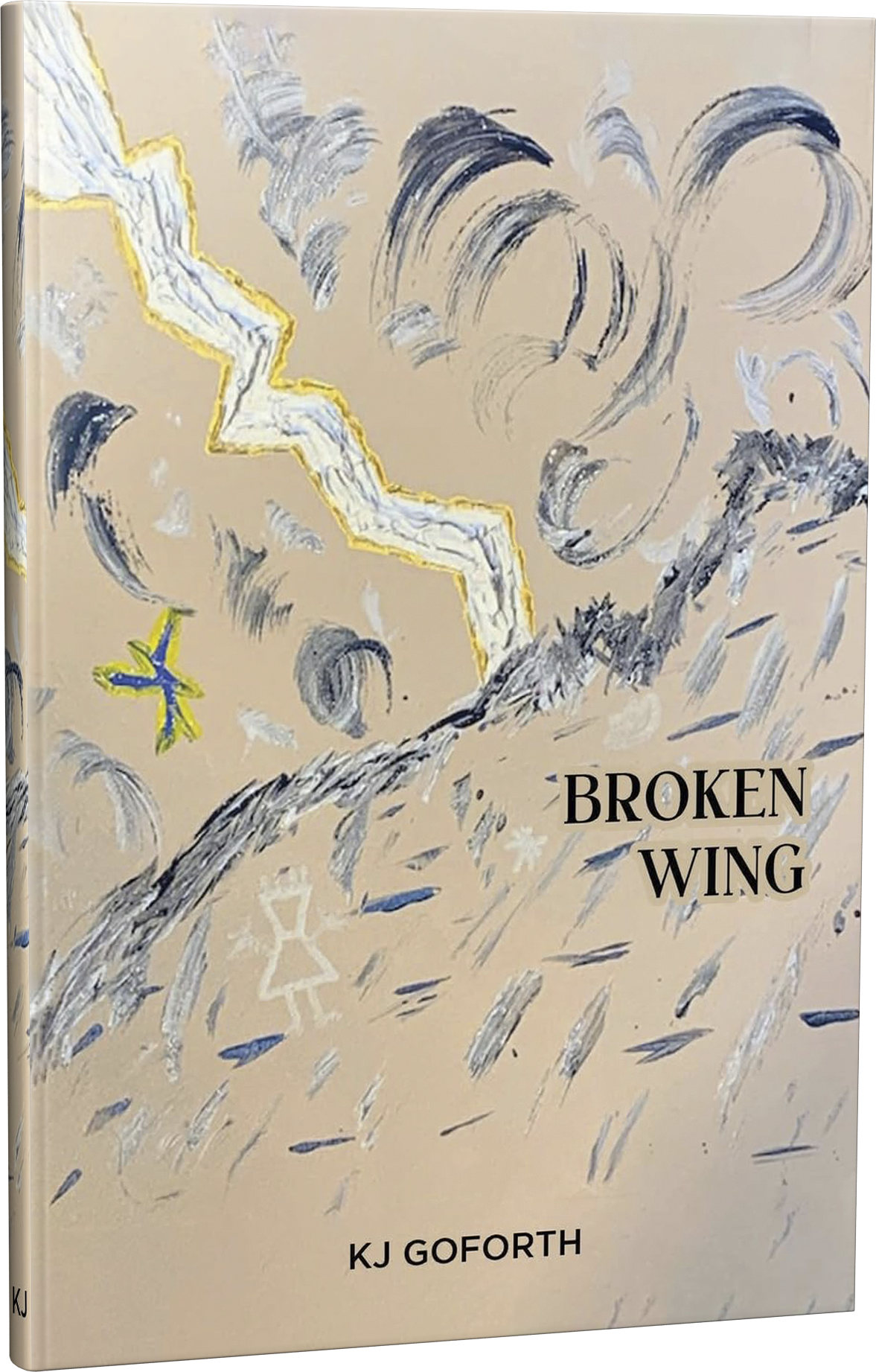
Broken Wing
“Trapped in bondage with broken wings Codependent history stings Growth groomed to stagnate Better wake up before it’s too late”
This collection of poems is a manifesto. The selections are the same length and format on each page, which is decorated with the same sword-pierced flag icon. The poems say that the time is ripe for an angel-warrior narrator, whose wings were clipped by the world’s wars, power-mongering, and conformity, to look inward for the strength to fight back in love and freedom. This idealistic message, the narrator admits, is at times dreamlike, too good to be true, and too simple to believe. Images of springtime, affection, and astral wonder, though not as plentiful as images of ways the world has let the narrator down, still outweigh them. The tone is indefatigable in both its righteous anger and its faith.
The mysterious narrator reveals a history as a soldier, as well as a life of crime. A craving for women is also confessed. One poem addresses a brother. However, the majority of the poems are impersonal. They are rallying cries for anyone with a message to wake up, as the narrator does, from the past, from old ways, the deleterious effects of following the world order of greed and killing (people, animals, and environment). Conformity, seen in organized religion, is another trick the world uses to betray people and keep them back. Most poems include some recognition of these problems as well as solutions in the form of expression, relaxation, and true relationships.
Slang and rhyming couplets cut through the seriousness with a rap-like quality. The rhythm and wordplay display a delight in language and in life. While the time for a revolution is urgent, the poems’ levity suggests that, in some ways, it has already come. Taking time to love and pursue art, such as poetry, shows freedom in action. GoForth’s poetry both intrigues and cajoles.
— The U.S. Review of Books (2024)
Book review by Mihir Shah